
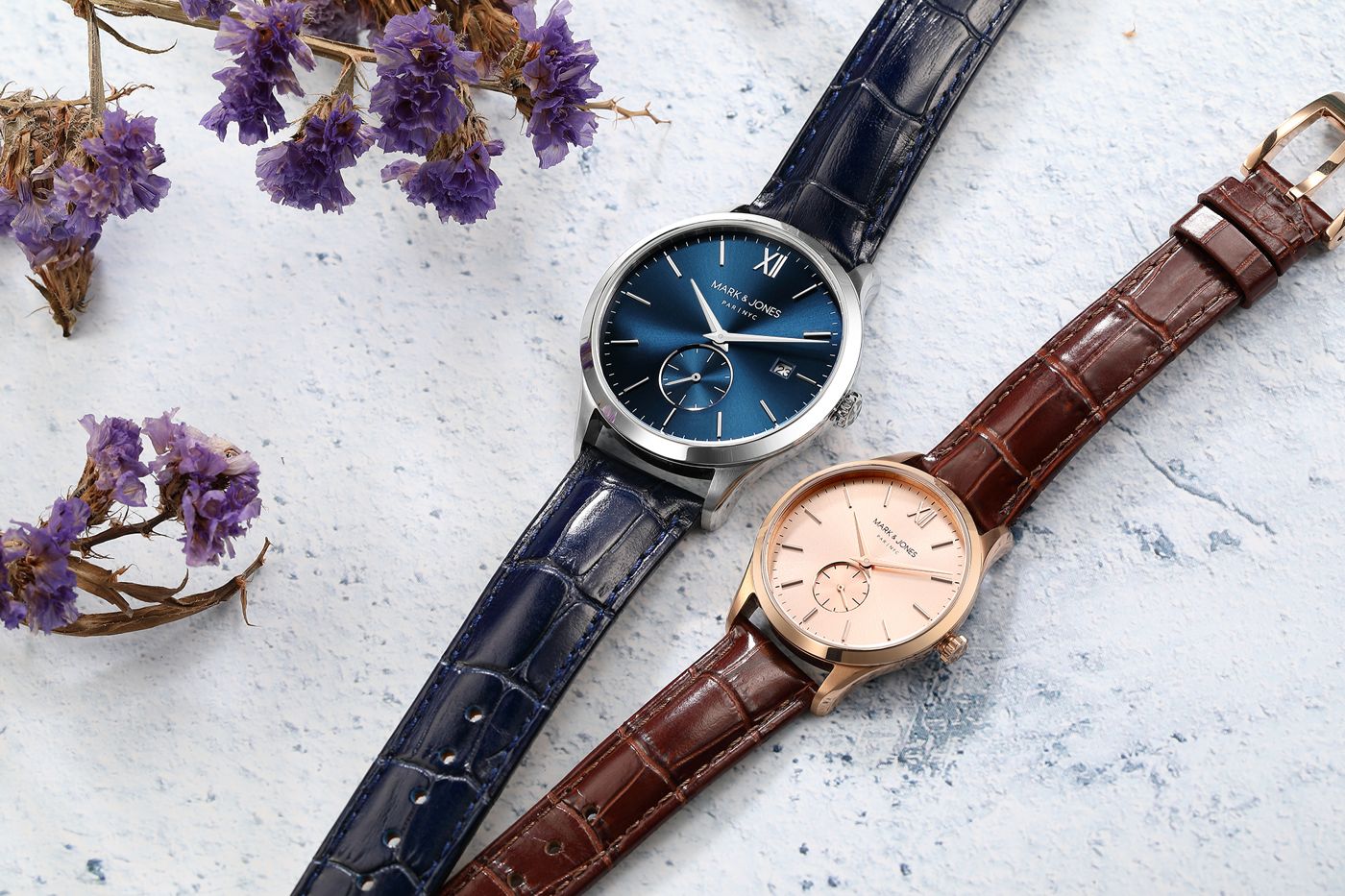
Every brand entering watches faces the same fork: build a custom watch from the ground up, or start from an off-the-shelf model and make it yours. Both routes produce real products. They differ in cost, speed, control, and how much of your brand ends up in the final piece.
Based on our experience helping brands launch watch collections across both paths, we have seen the same decision play out dozens of times. The right choice depends less on budget and more on what stage your brand is at — and how much of the visual identity needs to live in the watch itself.
The Two Routes, Defined
Off-the-shelf models are existing case and movement combinations that a manufacturer already produces. You choose the dial, strap, case finish, and packaging, and the factory assembles your configuration. Nothing mechanical is developed from zero. This is the approach most successful first-time brands take — and it is what we describe in Watch MOQ Explained: Why Pricing Isn’t Just Unit Cost.
Custom watches involve new tooling and development: a case designed to your geometry, proprietary dials, sometimes custom hands or crowns. The result is a watch nobody else can produce. For brands considering this path, Watch Design to Prototype: The Complete Custom Watch Process breaks down what that process actually involves.
Cost and MOQ
Off-the-shelf routes avoid tooling costs entirely. MOQs are lower — often 300-500 pieces — because the factory is using existing production lines. Custom development adds tooling and engineering fees on top of unit cost, and MOQs rise to 1,000+ pieces to justify that investment.
For a first collection testing market response, the off-the-shelf route is almost always the lower-risk starting point. The cost difference is substantial: a typical off-the-shelf quartz model at 300 pieces runs $15-25 per unit, while a custom case design at the same quantity can reach $35-60+ per unit before tooling fees. For a detailed breakdown, see Why the Same Watch Costs $5 or $15 — Pricing Logic.
Lead Time
Off-the-shelf models can reach production in 4-8 weeks, because there is no development phase. Custom watches typically add 3-6 months for tooling, sample iterations, and validation. If your launch window is fixed, that difference decides the route for you.
For a realistic timeline of what to expect, read How Long Does Watch Production Actually Take? and Watch Manufacturing Delivery Delays: 7 Common Causes.
Brand Fit and Differentiation
This is where the real trade-off lives. An off-the-shelf model with your dial and strap can look like your brand — but the case shape will still be familiar to anyone who has seen similar catalogues. A custom watch owns its silhouette. For brands whose visual identity is their core asset, that difference can justify the extra cost and time.
The key question is: does your brand compete on design uniqueness, or on brand storytelling and price? If the answer is design uniqueness, custom is worth it. If the answer is storytelling, an off-the-shelf model with a strong dial design may serve you better — and cost 40-60% less.
When Custom Is Worth It — and When It Isn’t
- Choose off-the-shelf when: you’re testing the category, your launch window is tight, or your budget doesn’t yet absorb tooling costs. This is also the right choice if this is your first watch — learn the process with lower risk before committing to custom tooling.
- Choose custom when: your brand lives in distinctive proportions or materials, you’re building a collectible item, or you want a design that competitors can’t copy next season. Custom also makes sense if you have existing sales data proving demand for a premium price point.
Many brands do both: an off-the-shelf first collection to validate demand, then a custom follow-up once the category has proven itself. For a comparison of OEM and ODM approaches that overlap with this decision, see OEM vs ODM Watches: Which Model Is Right for Your Brand? and Factory vs Trading Company: What Watch Brands Get Wrong.
The route isn’t a permanent identity — it’s a stage in your watch process. For brands just starting, Before You Contact a Watch Factory: 5 Decisions to Make First walks through the decisions that should come before this one.
What is the difference between custom watches and off-the-shelf models?
Custom watches vs off-the-shelf models comes down to tooling: custom watches involve new tooling, proprietary case design, and custom components. Off-the-shelf models use existing case and movement combinations — you choose the dial, strap, finish, and packaging, but the case shape is shared with other brands.
How much more does a custom watch cost compared to off-the-shelf?
A custom watch typically costs 40-60% more per unit than an off-the-shelf model at the same quantity, plus tooling fees of $2,000-10,000+. MOQ for custom is usually 1,000+ pieces vs 300-500 for off-the-shelf.
Should I start with an off-the-shelf model for my first watch brand?
Yes, for most first-time brands. Off-the-shelf models let you test market demand with lower cost and faster lead time (4-8 weeks vs 3-6 months). Move to custom only after you have sales data proving demand for a premium price point.
Can I switch from off-the-shelf to custom later?
Yes. Many brands launch with an off-the-shelf first collection, validate demand, then invest in custom tooling for their second collection. The off-the-shelf models can remain in the lineup as entry-level options while custom models serve the premium tier.
Sources: Industry pricing data from Federation of the Swiss Watch Industry annual reports; Statista global watch market data.