
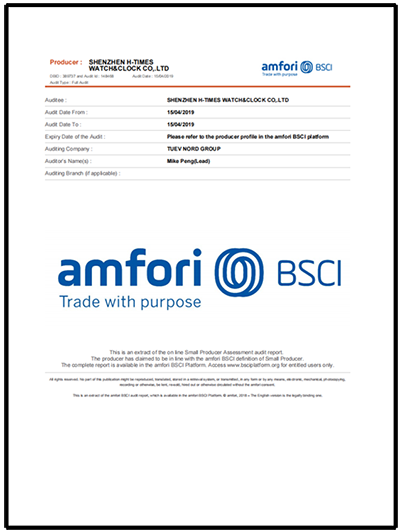
Certifications are one of the few objective signals a buyer has when evaluating a factory from a distance — they can’t visit the production floor themselves before placing an order, so a recognized standard becomes a proxy for trust. Here’s what the common certifications in watch manufacturing actually verify, and how to use them as part of your due diligence rather than the whole of it.
ISO 9001: Quality Management, Not Product Quality
For a bulk buyer, ISO 9001 is the certification to look for first: it certifies that a factory has a documented, consistently followed quality management system — not that any specific product meets a particular quality bar. In practice, this means a factory with ISO 9001 has traceable processes for how it handles orders, inspects components, manages non-conformance, and documents corrective action.
This matters for a bulk buyer because process consistency is what prevents quality from drifting across a 500+ unit run. A factory without a formal quality management system can still produce a good sample, but has less structural protection against inconsistency once volume scales up.
Watch-Specific Testing Standards
Beyond general quality management certification, a few watch-specific standards are worth asking about directly: water resistance testing (commonly referenced against ISO 22810 for water-resistant watches), which verifies the case and crown sealing actually perform at the rated depth rather than just claiming a number on the spec sheet. Movement accuracy testing, particularly for quartz movements, confirms timekeeping performance meets the stated tolerance. And material compliance certifications (such as nickel release testing for cases and straps, relevant for EU market compliance) matter if you’re selling into regions with specific regulatory requirements.
Not every factory tests for all of these by default — it’s worth asking specifically which tests are performed as standard on your order versus available as an add-on.
How to Use Certifications in Your Evaluation
Ask for the actual certificate, not just a claim — a legitimate ISO 9001 certification is issued by an accredited certification body and includes a certificate number you can verify. Ask what testing happens on your specific order, not just what the factory is generally capable of — general capability and what’s actually applied to your production run aren’t always the same thing. And treat certification as one input among several, alongside a physical sample inspection, references from other buyers where possible, and a clear written quality control process for your order.
A factory that certifications alone would make invisible is one that has no documented certifications and can’t clearly explain its quality process when asked directly — that combination is worth treating as a flag regardless of price.
Our Quality Certifications and Process
HTIMES maintains ISO 9001 quality management certification, and our production process includes component-level inspection, movement accuracy testing, and water resistance testing as standard steps within our five-stage OEM/ODM process, not as optional add-ons. We’re glad to provide certificate documentation and a detailed breakdown of our QC process as part of your evaluation.
Frequently Asked Questions
It certifies a consistent, documented quality management process rather than guaranteeing a specific product outcome — but that process consistency is exactly what protects quality at bulk volume.
Water resistance testing, movement accuracy testing, and material compliance testing (such as nickel release limits) are the most relevant, depending on your target market and product specification.
Yes, we’re glad to provide certificate documentation along with a breakdown of what’s tested as standard on your order.
Not automatically, but it removes one useful data point from your evaluation — in that case, a physical sample inspection and a clear written QC process become even more important to verify independently.
Get Started
If certifications and quality process are part of your factory evaluation, request a quote and our ISO 9001 documentation and QC process breakdown — every watch ships with CE and RoHS compliance — and we’ll send it over along with a production sample if you’d like to inspect one directly.