
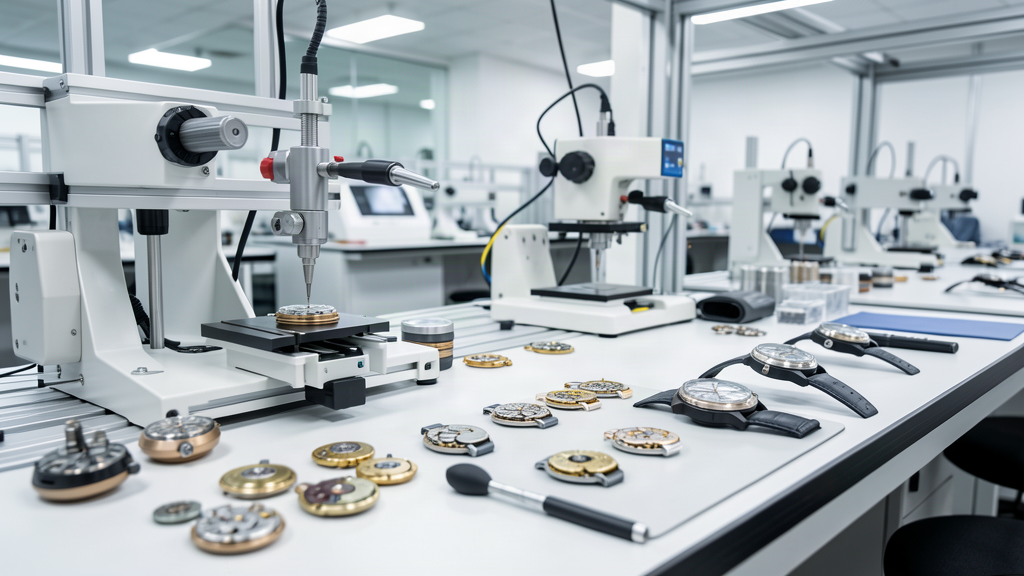
The finishing is clean. The weight feels right. The material quality is exactly what you asked for. The crown operates smoothly. You sign off, and mass production begins.
Then the shipment arrives.
The finishing isn’t consistent. The plating color is slightly off. The clasp is assembled differently. The dial printing has drifted in ways you didn’t expect. Nothing catastrophic — but enough to be a real problem.
This isn’t bad luck. And in most cases, it isn’t factory carelessness either. (And if you’re worried about the opposite risk — your design being copied — here’s how manufacturers handle IP protection.)
It’s the result of three specific, predictable gaps between sample approval and mass production — gaps almost nobody talks about openly, but ones that show up far more often in this industry than most brands realize.
The Three Real Reasons It Happens
Sample vs Mass Production: What Actually Changes
When a sample passes and production fails, the design hasn’t changed — the context has. Three things shift between a single prototype and a full production run:
- Tolerance stacking: A sample is assembled by one technician who can compensate for small variations. Mass production assembles hundreds of units from multiple batches, and tiny component deviations compound.
- Human consistency vs. process consistency: A skilled technician can hand-fit parts in a sample. Production relies on repeatable processes — when a process drifts (plating time, heat setting, pressure), every unit after it drifts too.
- Material batch variation: The sample may use one leather lot, one plating bath, one dial print run. Production draws from multiple batches, and slight differences between batches become visible at scale.
Understanding these three shifts is the first step to preventing sample-to-production failure — the reasons below explain how each one actually plays out.
Reason One — The Price Gets Renegotiated After the Sample Is Done
Many first-time brands assume the sample represents a fixed product. In reality, the sample represents a product built around a specific cost structure. When the economics change, the product usually changes with it — even if the visual design looks the same.
This is the most common cause of the sample-to-production gap, and the least talked about.
Here’s how it usually plays out. The brand pushes for a perfect sample — and gets one. It looks flawless. Everyone’s happy. Then, before placing the mass production order, the brand starts negotiating the price down. Sometimes they take the sample to other factories to shop for a cheaper quote.
To win the order, the factory agrees to the lower price.
What nobody says out loud: that sample was built at the original price. The materials, the components, the finishing standard, the assembly time — all of it was calculated against that number. Lowering the price doesn’t lower the cost of doing it right. It just moves the cost somewhere else.
So the factory finds a way to make the new number work. A slightly cheaper plating process. Sometimes the changes are visible; sometimes they’re subtle — a different plating supplier, a marginally thinner coating, a loosened QC rejection threshold, or a different component supplier who meets spec on paper but doesn’t feel quite like the approved sample. Maybe it’s a component supplier who quoted lower, or an assembly step that got shortened but still clears basic inspection. None of these changes get announced. None of them get agreed to in advance. They just happen — because the order’s economics require it.
The brand receives the production batch and notices it feels different from the sample. They’re not wrong. It is different.
This isn’t unique to any one factory or market — it’s a structural reality of manufacturing: you get what you pay for, and if the sample’s price changes, the product changes with it.
This doesn’t mean negotiation should be avoided. It means negotiation belongs before the sample — when both sides are designing toward the same target, and the factory can show you what different price points actually produce — not after, when a lower price comes at the expense of a product that already proved itself.
Reason Two — Nobody Wrote Down the Production Standard
This shows up most often when the team that built the sample isn’t the same team running mass production.
The technician who carefully assembled your sample may not be the operator handling hundreds of production units later.
This second gap is quieter, but just as damaging.
Once a sample is approved, there’s usually an unspoken assumption: “we know what we want now.” The brand has seen the sample, the factory has produced it, so mass production will obviously match it.
But “we know what we want” isn’t a production standard. It’s an assumption.
In practice, the specific details that made the sample good — plating color, lume brightness range, consistency of brushed and polished finishing, the torque feel of the crown — were never written down. They exist in the sample itself, and in the memory of whoever approved it.
When mass production starts, a different team executes it. They’ve never seen your sample. They work from general instructions and their own professional judgment. When a component comes from a slightly different batch — common in mass production — they judge acceptability based on what they know, not what you know.
Plating color 5% warmer than the sample? That’s within normal supplier batch variation. The production team signs off. You notice the color mismatch the moment the shipment arrives.
In the conventional sense, nobody made a mistake. The mistake happened earlier — when the standard existed only as a physical object, not a written specification.
Reason Three — Volume Compounds Variation
Even when everything is done right — price agreed upfront, standards documented — mass production introduces natural variation that a single sample can’t reveal.
A slight deviation in one case is imperceptible. But 300 cases, each drifting slightly out of tolerance in the same direction; 300 dials printed under marginally different pressure conditions; 300 assembly passes — these differences interact and compound.
For example, a batch plated at a slightly higher temperature might be acceptable on its own. A batch of dials printed slightly darker might also be acceptable on its own.
But combine both variations within the same production batch, and the whole watch suddenly feels noticeably different from the approved sample — even though each individual component technically stays within the supplier’s normal tolerance.
What’s imperceptible in a sample becomes visible as inconsistency across a batch.
This isn’t a quality defect. It’s a characteristic of volume production. The real question is whether your acceptance standards account for it, and whether your QC process is built to catch it before the full batch is done — not after.
Why Post-Sample Price Negotiation Creates a Structural Problem
It’s worth being direct about this, because it’s an uncomfortable truth in this industry.
When a brand receives a good sample and then goes looking for a lower price — whether from the same factory or a different one — the implicit expectation is that the same product will arrive at a lower cost.
That’s not how manufacturing works.
Every part of a watch’s quality carries a cost: component grade, plating process, assembly time, QC checkpoints. When the total price drops, something in that chain shrinks with it. The brand may not be able to pinpoint exactly what changed. The watch knows.
A factory that accepts a price far below market isn’t being generous. They’re solving a math problem — and the answer shows up in the product.
The right time to negotiate price is before sampling — when both sides are designing toward a shared target, and the factory can show you what different price points actually produce. At that stage, the trade-offs are visible and deliberate. After the sample, those trade-offs become invisible and one-sided.
If another factory quotes significantly less for the same sample, the useful question isn’t “can you match this price?” It’s “what would be different about the product at this price?” Get that in writing before you decide.
Pre-Production Checklist: What to Lock Down Before Mass Production Starts
This is what experienced watch brands do before approving mass production. Every item on this list represents a gap that, left unaddressed, shows up as a problem when the shipment arrives.
Component Specifications — Lock Down What’s Inside the Watch
- All components (case, dial, movement, hands, glass, crown, strap, clasp, packaging) confirmed from the actual production supplier — not the sample substitute or leftover stock.
- Material grade for every component confirmed in writing (e.g., “316L stainless steel,” not “stainless steel”).
- Component lead times confirmed — no mid-production substitutions due to stock shortages.
- If the price was negotiated down from the sample quote: written confirmation of exactly which components or processes changed, and agreement that those changes are acceptable.
Visual Acceptance Standards — In Writing
- Plating color reference defined against a physical sample, not a screen photo.
- Acceptable plating color deviation range documented (pass / fail).
- Dial printing consistency standard defined and photographed.
- Lume brightness range defined (acceptable minimum and maximum).
- Case finishing standard documented — brushing direction, depth, consistency across units.
- Logo placement tolerance defined (acceptable offset range).
Functional Standards
- Timekeeping accuracy tolerance confirmed (e.g., quartz ±15 seconds/month).
- Water resistance testing method defined: per-unit or batch sampling — and the corresponding ATM rating.
- Crown operation standard defined: torque feel, push-pull resistance.
- Clasp/buckle seating standard defined.
Process and QC Checkpoints
- The factory has a written assembly process for this specific model — not a generic SOP.
- In-process QC checkpoints confirmed at each assembly stage, not just final inspection.
- Rework and rejection policy defined: what happens to units that fail QC? Who decides, and who pays for rework?
- Batch variation monitoring: how does the factory track consistency throughout the production run?
Pre-Shipment Confirmation
- Pre-shipment inspection planned: internal QC, third-party inspector, or brand representative.
- Final photos or video of randomly sampled units provided before final payment.
- Packaging and labeling confirmed against the approved standard.
If any item on this list is unchecked, the production conversation isn’t finished yet.
Supplier Stability
- Key suppliers locked before production begins.
- No supplier substitutions without written approval.
- Critical visible components (dial, plating, hands) traceable to an approved supplier batch.
The One Question That Changes Everything
Before approving any sample for mass production, ask the factory this:
“If I reorder this watch six months from now — same spec, same components, same suppliers — will it look and perform exactly like this sample?”
If they answer without hesitation, ask them to walk through exactly how. What’s documented? Which suppliers are locked? What does “exactly the same” mean as a QC standard?
If they pause — or if the answer includes a qualifier like “it should be very similar” — that hesitation tells you something important about how much of a real production system is actually in place.
The brands that consistently get mass production right aren’t the ones with the best sample. They’re the ones who treat sample approval as the start of a system-building conversation, not the end of a design conversation.
If You’ve Already Received a Problematic Batch
If the shipment has already arrived and doesn’t match the sample, the instinct is to direct frustration at the factory.
Before that conversation, ask yourself two questions.
Was the price negotiated after the sample? If so, that’s likely where the gap originated. The conversation with the factory needs to establish why and specifically what changed as a result of the price change — not just what this batch looks like.
What acceptance standards did we actually put in writing before production? If the answer is “we assumed it would match the sample,” both sides bear some responsibility for the gap. The factory had no written standard to execute against — and neither did you.
Neither question is about assigning blame. They’re about understanding where the process broke down, so the next production run doesn’t repeat it.
For a broader look at catching production problems earlier in the process, How to Avoid Production Surprises in Watch Manufacturing maps the full production timeline and where risk typically shows up.
We once worked on a project where the approved sample showed a very clean, consistent rose gold plating tone.
Before mass production, the price was renegotiated down significantly to hit the brand’s target retail margin. The visual design stayed the same, but several sourcing decisions were adjusted behind the scenes to make the new pricing work.
To hit the delivery date, part of the production run used a different plating supplier, and the acceptable deviation range in QC was loosened slightly.
Individually, none of these changes seemed significant. But once the full batch arrived, the client immediately noticed the overall plating tone no longer matched the original sample.
The issue wasn’t that the factory deliberately misled the client. It was that the production system itself had changed after the sample was approved — while the client’s expectations were still anchored to the original sample standard.
For the next production run, the project was structured differently:
The production price was locked before a new sample was built.
The plating supplier was fixed by written agreement.
A physical plating reference sample was signed and kept on file for QC comparison.
Supplier changes required written approval in advance.
Because the production standard was finally defined as a controlled system — not just a successful sample — the following run was significantly more stable.
Heading Into Mass Production?
If you’re moving from sample approval into production and want to identify where inconsistency typically creeps in before you place the order, we’re glad to review your production structure with you.
Most production problems don’t start in shipping. They start earlier — when assumption replaces a written standard.
👉 Talk to us about your project
Why do perfect watch samples fail in mass production?
Samples are built individually by senior technicians with unlimited time. Mass production moves through an assembly line where each operator handles one step repeatedly. The gap between sample and mass production quality is almost always an assembly discipline gap — not a materials problem.
How can I prevent sample-to-mass-production quality gaps?
Lock in every specification before mass production starts: tolerances, surface finish standards, assembly procedures, and QC checkpoints. Create a written standard that the factory signs off on. For the full process, see watch quality inconsistency and why it happens.
What is the acceptable quality difference between a sample and mass production?
A well-controlled production line should produce 95-98% first-pass yield — meaning the mass production watches match the sample’s quality level within 2-5% tolerance. If your rejection rate exceeds 5%, the production standard was not properly locked down.
Should I order a second sample batch before mass production?
For orders above 500 pieces, a pre-production batch of 30-50 pieces is worth the cost. It reveals assembly-line issues that a single handmade sample never will. For smaller orders (50-300 pieces), the rendering approval and first-article inspection should be sufficient.
Sources: Industry quality data from Federation of the Swiss Watch Industry; ISO 9001 quality management principles.
Based on our experience manufacturing watches in Dongguan since 2009, the gap between sample approval and mass production quality is the single biggest risk in watch manufacturing. We have learned that a pre-production trial assembly run catches 70% of issues before full mass production begins.
Related: Watch Assembly Before Shipment | Common Causes of Watch Manufacturing Delays | Watch Quality Control in Mass Production
Sources: Watch (Wikipedia) · Federation of the Swiss Watch Industry